What Lighting Automation Really Gives You
From one button in a small apartment to a villa where family, guests and staff keep their own rhythms — why lighting control was never really about switches.
Nikolai Atapkov
Founder / CEO
9 min read
“Why would I automate my lights? My apartment is small. I can reach every switch myself.”
After years of working on residential projects, we have heard this argument many times. And to be fair, it is perfectly reasonable. You do not need a sophisticated engineering system to turn on a light in a small apartment: people are very good at pressing switches.
But we are asking the wrong question. We are discussing how to turn on a lamp, when the real question is how a home should make us feel — and how much attention it should demand.
We have been designing home automation since 2008, and in Dubai since 2022. The more complex the homes become, the clearer one principle gets:
“ Good technology does not add another interface to daily life — it removes dozens of small decisions. ”
We have already written about this in detail in “Luxury Smart Home — and Other Overused Words in UAE Construction”. Here is what the idea means for lighting — from a studio to a large estate.
01.A small apartment: one button, several things taken care of
Consider a studio or a compact apartment. The living room may also be the workspace, dining room and home cinema. There are only a few lighting circuits, and every switch is a short walk away.
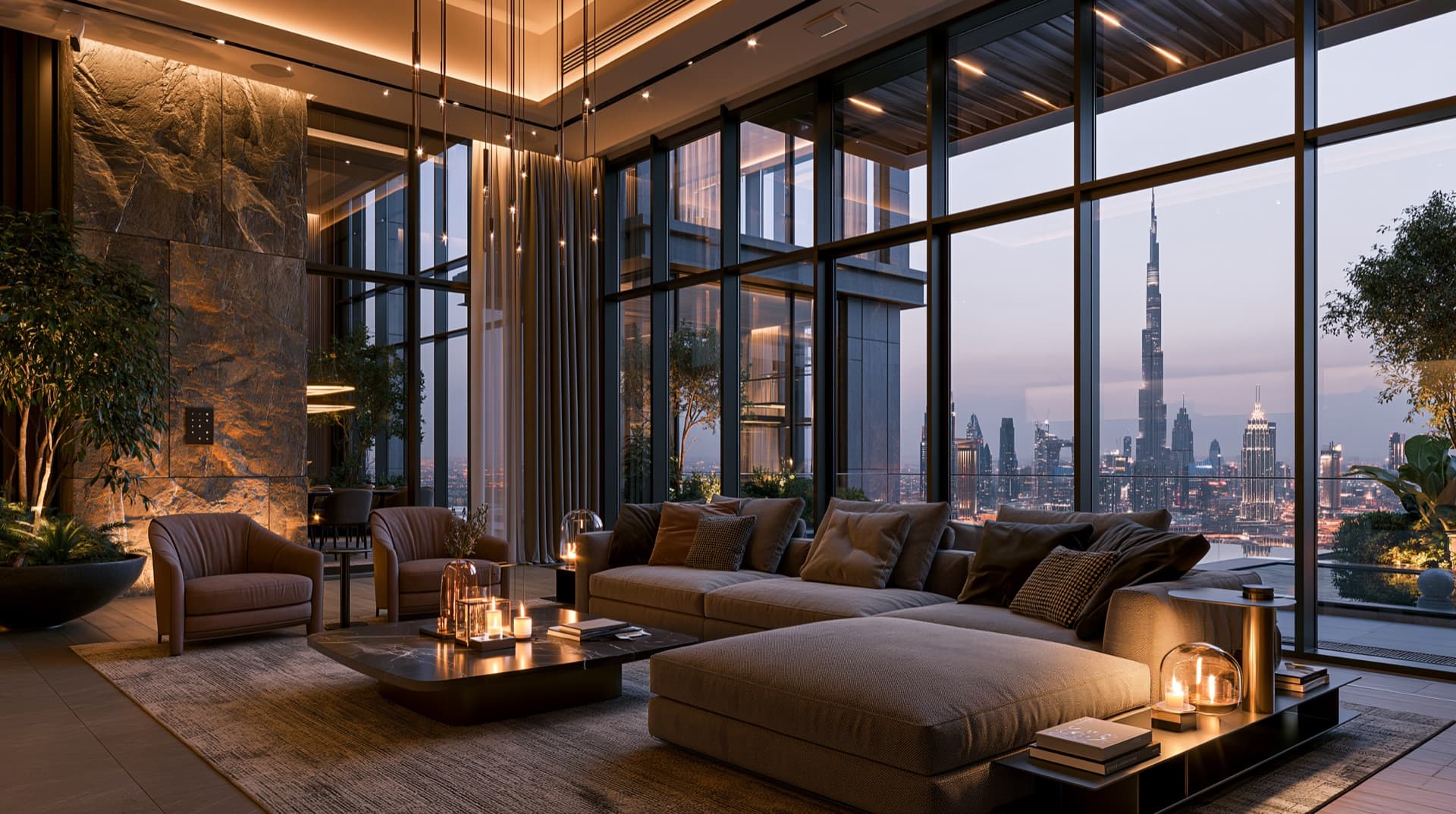
Yet the same room can feel entirely different when bright task lighting gives way to a softer evening composition. A wall texture comes forward. The dining table is gently illuminated. Light near the sofa becomes more discreet. Instead of adjusting five circuits one by one, you select “Evening”, and the room changes as a whole.
Leaving home can be just as simple. Rather than going from room to room, you take one action: unnecessary lights go off, the music stops, the curtains close and the air conditioning moves into a more economical mode. When you come back, the apartment returns to the way you like it. In a small home, none of this is essential. It is a conscious choice in favour of comfort, aesthetics and fewer interruptions.
What about the savings? Here is an example from our own measurements. Take a one-bedroom apartment where the air conditioning runs around the clock, holding 22 °C. That costs roughly AED 400–700 a month, depending on the building, the weather, the curtains and other details. The owner is at home about half the time and is usually out during the hottest hours of the day.
The “Away” scene raises the thermostat setting to 26 °C and closes the curtains at the same time, shutting out direct sun. There is noticeably less heat for the air conditioning to remove. By our measurements, that meant AED 100–150 a month in direct savings, without anyone lifting a finger. Over a year, it adds up to AED 1,200–1,800 for a one-bedroom apartment. But promising a specific figure to every owner would be misleading: the outcome depends on the property, billing arrangement, equipment, commissioning and actual use. We see efficiency as a potential benefit, not the reason to build the system.
02.Two or three bedrooms: the home follows the family
Now consider an apartment with two or three bedrooms. Several people live there, with different routines and different ideas of comfort.
In the morning, parents are getting the children ready for school and rushing to work. Nobody wants to inspect every room before leaving — the “Away” scene puts the apartment into a defined state. Later that evening, when the children are asleep, the brief is entirely different: lower the brightness, preserve the quiet and create a more relaxed setting for the adults.
There is “Dinner”. There is “Movie”, where the picture is not fighting the room lighting, the curtains close and the temperature remains comfortable. There is “Night”, with just enough light to find your way to the bathroom without waking the household. The point is not how many scenes the system can store. It is whether those scenes reflect the way people actually live, rather than the feature list of a product.
I have lived with these systems for years, across different apartments and countries. My conclusion is personal. When the lighting looks just right, when the air is neither too warm nor too cold, when music, light and space are working together rather than competing for attention, something important happens: you can simply be at home.
Spend time with your family. Unwind. Recover from the working day. Those moments are among the reasons we work so hard in the first place. They are difficult to value in dirhams — but to me, they are the real return on a well-designed home.
03.Why not just install sensors?
That is a fair question, especially for corridors, bathrooms, dressing rooms and staircases. Automatic lighting is often more convenient than a wall switch in these areas.
But a motion sensor and a well-designed lighting scene are not the same thing. A basic sensor detects movement and switches the light on for a fixed period. More considered logic takes into account ambient light, the time of day, occupancy, the direction of movement and the scene already running. During daylight, no artificial light may be needed at all; at night, the light can come on gradually, at a much lower level, without a sudden blast of brightness.
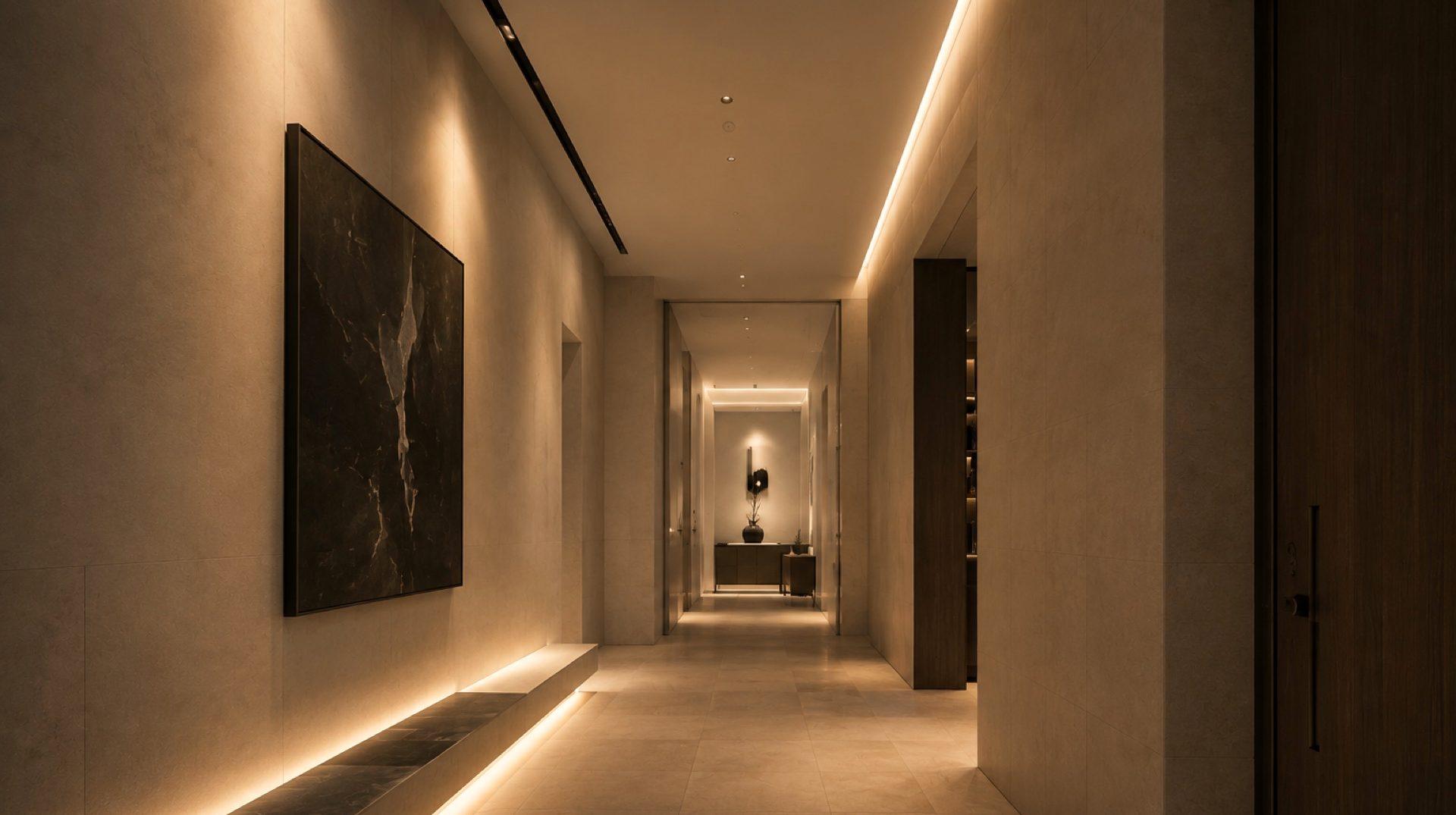
One of our favourite examples is a 15-metre corridor in a private villa in Dubai. Working with the interior design team, we positioned the spotlights and shaped their beams to create a deliberate visual rhythm along the whole passage. Creatrol sensors and KNX logic allowed the lighting to respond in sequence as someone walked through the space.
Each group fades up smoothly, from zero to its set level over 1.75 seconds. Yes, that precise. Walk one way and the light appears to unfold ahead of you. Walk back and the effect reverses. When the relevant lights are already on, the system leaves them alone.
Could anyone live without this? Of course. But details like this are what clients sometimes describe as magic — and a corridor that was once just a way to get from one room to another becomes part of the architectural experience.
Sensors deserve an article of their own: different technologies bring different capabilities, limitations and applications, and we will explore them separately. In the meantime, here is one example from KNX Mall, the KNX equipment store we run: the narrow-zone Creatrol Mini PIR Curtain motion sensor.
04.A villa: scenes become part of the architecture
As we move on to villa automation, the scale changes. Beyond the main rooms, there are staircases, terraces, a garden, guest suites, studies, a gym and sometimes a private cinema. Lighting is no longer a collection of unrelated circuits.
Zoning and context become the priority. The house may be only partially occupied: the family is relaxing in the living room, someone is working in the study, a child is asleep, guests are out on the terrace. Switching the whole house on or off at once makes little sense.
A good scene addresses the spaces that matter, while respecting what is happening in the rooms around them. “Entertaining” is not simply brighter lighting. It is the approach from the entrance, softly lit architecture, comfortable illumination at the dining table and discreet accents where you want the eye to go. “Late Evening” is a different composition altogether. “Night” offers safe circulation without making the house feel fully awake.
This is where collaboration between the lighting designer, interior designer and automation engineer becomes essential. Beautiful light starts with where the fixtures are placed: programming brings it out, but is no substitute for a good layout. Equally, a well-considered lighting design loses much of its potential when it is operated through dozens of disconnected switches.
05.A large estate: several lives, one home
When a large family lives in the house and staff work there as well, the logic of control itself changes. Adults and children have their own schedules, activities and guests.
Chefs, housekeeping and technical staff may be working at the same time. Someone is preparing dinner, someone is exercising, someone is watching a film and someone is hosting a meeting. It is one property, but several distinct lives unfolding in parallel.
In a home like this, a universal “All Off” button is no longer the centre of the experience. In an apartment, one button on your way out is the best scene of all. In an estate, without context, the same button can simply be the wrong tool: someone still needs light, staff are still at work, some rooms are still occupied.
So we design the system around levels of control:
- Personal comfort: bedrooms, studies and children’s rooms follow individual preferences.
- Shared experiences: living rooms, dining spaces, the cinema, entertainment areas and terraces have clear, useful scenes.
- Household operations: staff get simple control of the areas relevant to their work, without intruding on the family’s private spaces.
- The overall picture: the owner or an authorised estate manager can see the state of the systems and step in where it is genuinely needed.
Central supervision here is not about an impressive screen. It is about keeping a complex property manageable. Privacy matters just as much: visibility and control should not become an excuse to interfere with the household’s personal routines.
Can a home of this scale exist without lighting automation? Absolutely — we have seen it. People spend a lot of time walking between rooms, switching circuits on and off by hand, or they leave lights on because it is easier. With a large running budget, this may not even feel like a problem.
But when a home has already been designed with dozens or hundreds of lighting groups, a reasonable question remains: why should such sophisticated architecture depend on someone going from switch to switch?
06.A home where you can simply be
Back to the question we started with: why automate the lights when you can reach every switch yourself? You can, of course. But in a studio, scenes spare you a dozen small actions every evening and can trim the air-conditioning bill. In a family apartment, they let the children sleep while the adults have dinner. In a villa, the lighting design becomes part of the architecture. And in a large estate, the home stays manageable without intruding on anyone’s private life.
We do not believe everyone needs automation. Sometimes a few well-chosen scenes are enough; sometimes a home needs a complete wired infrastructure for lighting, shading, climate and audio. That is why we begin a conversation about lighting not with switches or a product catalogue, but with a question: how do you spend your evenings at home? Who is in, which lights are on, what happens when you leave and when you come back. The scenes come from the answers — exactly as many as your home needs.
And when they are set up properly, you hardly ever think about the system. What remains is the point of it all: you can simply be at home.
Key takeaways
- The real question is not how to switch on a lamp but how a home should feel and how much attention it asks for.
- Good technology removes dozens of small decisions instead of adding another interface.
- A basic motion sensor switches a light on for a fixed period; a well-designed scene also takes into account ambient light, the time of day and occupancy.
- In a villa, scenes work by zone: they serve the spaces that matter without disturbing the rest of the house.
- In a large estate, control is organised in levels: personal comfort, shared spaces, household operations and the overall picture.
Written by
Nikolai Atapkov
Founder / CEO
Nikolai believes technology should work quietly within architecture, never compete with it. At BUTLER, he creates reliable, intuitive smart home systems designed to last.